ISR perception module, on third-party commercial computing.
It is the first application of our edge computing technology and the only one with published figures: perception that runs onboard an uncrewed platform and keeps producing intelligence when the link is not there. The airframe, the motors, the autopilot and the compute module are commercial; the perception and mission layer is ours.
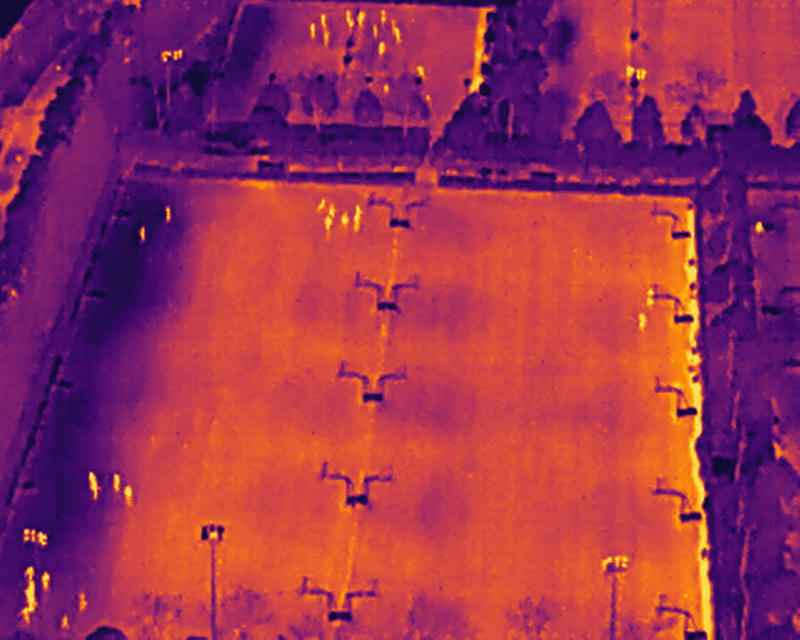
Thermal frame from the public HIT-UAV dataset (CC BY 4.0), with the boxes our model produces on it. Validation material, not an operational capture and not flight proof. Full citation in the legal notice.
People. Thermal, day and night.
The deployed model detects and geolocates people onboard. When the individual event matters, that is what gets transmitted; when there are many, the aggregate intelligence is sent instead.
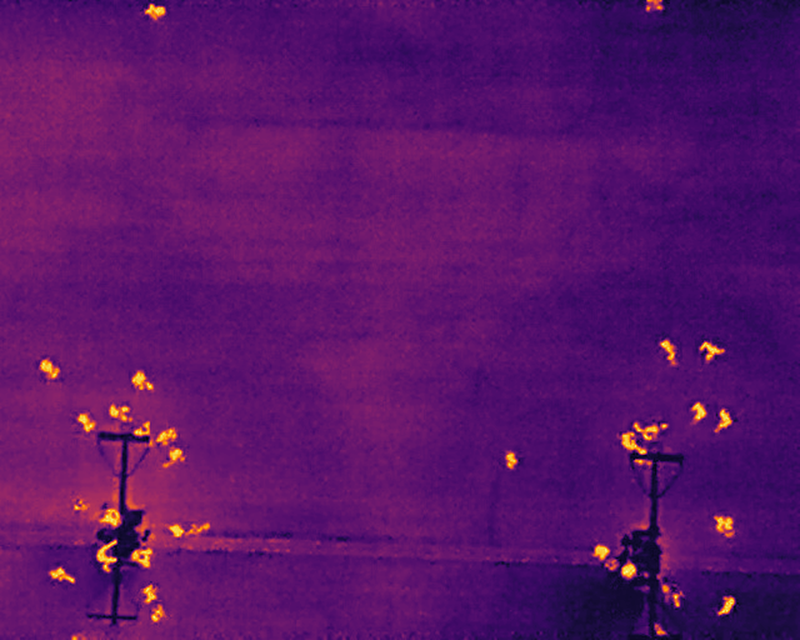
Illustrative validation frame · the boxes are the model's output over the public dataset, not an operational capture.
Perception software on commercial hardware.
It detects and geolocates people onboard, and emits compact events and alerts. Designed for missions whose intelligence cannot depend on a stable link.
What we are
- An ISR perception layer that runs onboard
- Companion software on a third-party COTS compute module
- Standard MAVLink integration, PX4 / ArduPilot agnostic
- Built for thermal (LWIR), day and night
What we are not
- We do not build aircraft or drones
- We do not build boards or compute modules
- We do not replace the autopilot
- We do not sell a closed platform
COTS companion computer, open autopilot, MAVLink.
Computing runs onboard, on a third-party commercial module, alongside the PX4 or ArduPilot autopilot and communicating over MAVLink. The output is not video: it is events and geolocated alerts, sized for low bandwidth.
- Computing
- Third-party COTS module (companion)
- Measurement surface
- NVIDIA Jetson Orin Nano Super · bench and demonstration
- Autopilot
- PX4 · ArduPilot
- Control bus
- MAVLink
- Sensors
- Thermal LWIR · RGB
- Output
- Events · geolocated alerts (CBOR contract)
- Link mode
- Store & forward / low bandwidth
- Authority level
- Passive · reads telemetry and emits events
- Declared maturity
- TRL 4 · bench evidence
L1 today. L2 and L3 ahead.
We are explicit about what is operational, what is validated only in simulation and what is vision.
- L1Demonstrated onboard
Edge ISR perception
Onboard detection and geolocation of people, with compact output tolerant to a degraded or denied link.
- L2Validated in SITL simulation (Jul 2026) · blocked on a real platform by agreement with the manufacturer
Perception-driven autonomy
Both halves travel together: it is validated in simulation and it is blocked on a real platform, and the block is commercial, not technical. What we ship is passive by decision: it reads telemetry and emits events, and does not act on the flight until an agreement with the platform manufacturer exists.
- L3Vision · 18-24 months
GPS-denied navigation
Robust navigation in GPS-denied environments, a necessary condition for contested missions.
Compact intelligence, not raw video.
Where bandwidth is scarce, the difference between transmitting video and transmitting intelligence is the difference between having a mission and not having one.
- 01
Typified events generated onboard
- 02
Geo-tagged, lightweight alerts
- 03
Persistent queue with acknowledgement through link outages (store & forward)
- 04
Opportunistic sync when the link returns
- 05
Event channel designed for end-to-end encryption and signed alerts — under integration, not a current capability.
Do you have a case where the computing has to happen on the device?
Let's talk. Institutional programmes, industrial integrators and allied partners.